
Quick Summary
Malfunctioning automatic gates compromise property security and create dangerous pinch hazards when electrical faults, misaligned sensors, or physical track binding halt daily operation. While basic troubleshooting involves checking GFCI breakers, cleaning optical photo-eyes, and manually testing for mechanical drag, complex motor and control board failures require specialized diagnostic tools to ensure UL 325 safety compliance. Property owners can rely on True Blue Gate Repair Santa Ana for transparent evaluations and schedule same-day driveway gate opener repair with a free estimate to restore dependable access quickly.
Driveway Gate Opener Repair: Troubleshooting and Service
When an automated entry gate stops working, getting your property secure again cannot wait. Whether you are dealing with a gate stuck open on a commercial lot or trapped in your own driveway on a weekend morning, you need a clear diagnosis and a reliable fix. Automatic gates are heavy, motorized systems, and when safety loops fail or limiters trip, they create real pinch and entrapment risks. Forcing a jammed gate or letting an untrained person guess at the wiring usually leads to stripped gears, burnt boards, and repeat breakdowns.[1]
A professional diagnostic approach starts with mechanical and electrical evaluations. Technicians, such as those from True Blue Gate Repair Santa Ana, test line voltage, calibrate safety photo-eyes, and check the physical gate balance before recommending replacement parts.[3] See also Gate Repair Quotes | 10% Off & Free Estimate | On-Site in 60 Minutes.
Driveway Gate Opener Repair: Fast Troubleshooting Summary
Quick Summary: Professional driveway gate opener repair tackles issues ranging from sensor misalignments and blown control boards to structural track binding and failing motors. No reliable national average for driveway gate opener repair was found in the reviewed neutral sources, as costs depend on the specific components and labor required. Before scheduling a service call, general practical advice suggests checking your dedicated breaker, resetting any tripped GFCI outlets, and cleaning optical photo-eyes.
As general practical advice, diagnosing an automated gate involves evaluating incoming power, safety sensor circuits, and physical mechanical drag. In many instances, reported electrical issues are actually mechanical resistance problems. Shifting soil, settling posts, or thermal expansion can cause the gate to bind, which trips the motor’s internal amp limiter to protect the unit from overheating.[2]
Immediate Safety Steps
As general practical advice, because automated gates exert substantial mechanical force and carry entrapment risks, take these precautions right away:
- Disengage the manual release: Turn the release key or pull the emergency latch pin to disconnect the drive arm or chain, allowing you to move the gate by hand.
- Cut the main power: Switch off the dedicated circuit breaker to prevent high-voltage contact or unexpected gate motion while you check the area.
Quick Diagnostic Checklist
As general practical advice, consider these diagnostic checks before calling for professional service:
- Power Supply: Check that the dedicated breaker has not tripped and the outdoor GFCI outlet is operational.
- Safety Photo-Eyes: Wipe off dust, cobwebs, and residue. Confirm the status LEDs on both sensors stay solid rather than flickering.
- Hinge and Track Drag: With the operator disengaged, push the gate by hand. If it scrapes the pavement or sticks in the middle of travel, the issue is structural rather than electrical.
What You Need Before Troubleshooting a Gate Opener
Before working on any motorized gate hardware, collect the proper diagnostic tools and safety equipment. No reliable national average for driveway gate opener repair was found in the reviewed neutral sources, but testing an opener without proper meters and hand tools can damage delicate circuit boards or create pinch hazards.[4]
Required Diagnostic Tools
As general practical advice, have a digital multimeter ready to measure both AC line voltage and DC low-voltage circuits. Keep your manufacturer wiring schematic nearby, along with insulated screwdrivers, socket sets, and non-conductive silicone spray. Soil shifts and seasonal temperature changes can cause physical drag on swing and slide gates, which can lead property owners to assume the motor is faulty when the system simply needs structural realignment.
Essential Safety Gear
Always wear heavy leather work gloves and safety glasses. Turn off the main breaker before opening electrical enclosures or touching high-voltage terminals. Professional technicians, including the specialists at True Blue Gate Repair Santa Ana, use specialized diagnostic equipment and circuit analyzers to ensure safe and accurate repairs.
Step 1: Check Power Feeds and Electrical Supply Integrity
Need driveway gate opener repair?
We’re available now — call for a fast, free estimate.
As general practical advice, verify that steady power reaches the primary transformer before assuming a control board has failed. Voltage drops, tripped GFCI outlets exposed to moisture, and aging backup batteries account for a significant portion of sudden gate shutdowns.
Testing Breakers and GFCI Outlets
- Inspect your main breaker panel and any outdoor sub-panels. Reset any tripped breakers firmly.
- Test outdoor GFCI receptacles. Moisture from rain or humidity can trip these sensitive safety outlets.
- Use a multimeter to measure the incoming AC voltage at the operator terminal block. Ensure the reading matches the manufacturer specifications (typically 115V or 230V AC) without significant voltage sags under initial motor load.
Inspecting Solar Panels and Battery Backups
If your system runs on a 12V or 24V DC battery backup or solar array, test the battery terminals under active load. A failing battery may show adequate voltage at rest but drop sharply when the motor attempts to start. This drop can cause the logic board to reset, mimicking a motor failure. Replacing the battery bank can often restore operation without replacing the entire gate motor.
Step 2: Inspect Photo-Eyes and Safety Sensor Alignment
Monitored safety photo-eyes prevent gates from closing on vehicles, pedestrians, and obstacles. If your motor clicks or indicates an error code but the gate will not close, the safety circuit may be open.
Cleaning Optical Lenses and Checking Alignment
- Clean the lenses: Wipe away dirt, spiderwebs, lawn debris, and residue from both optical faces.
- Check the status LEDs: Look at the diagnostic lights on both the transmitter and receiver. A solid LED generally indicates proper alignment, whereas a flashing or unlit LED indicates the beam is obstructed, misaligned, or unpowered.
- Check sensor mounts: Make sure the mounting posts or brackets have not been shifted out of alignment.
Diagnosing Weather and Moisture Intrusion
Open the sensor covers to look for condensation, moisture, or insect intrusion inside the housing. UL 325 remains the core safety standard for automated vehicular gate operators, with recent updates noted in 2025-2026 requiring monitored entrapment protection sensors designed to resist weather and prevent false obstruction signals.
Step 3: Test Mechanical Drag, Soil Shifting, and Structural Resistance
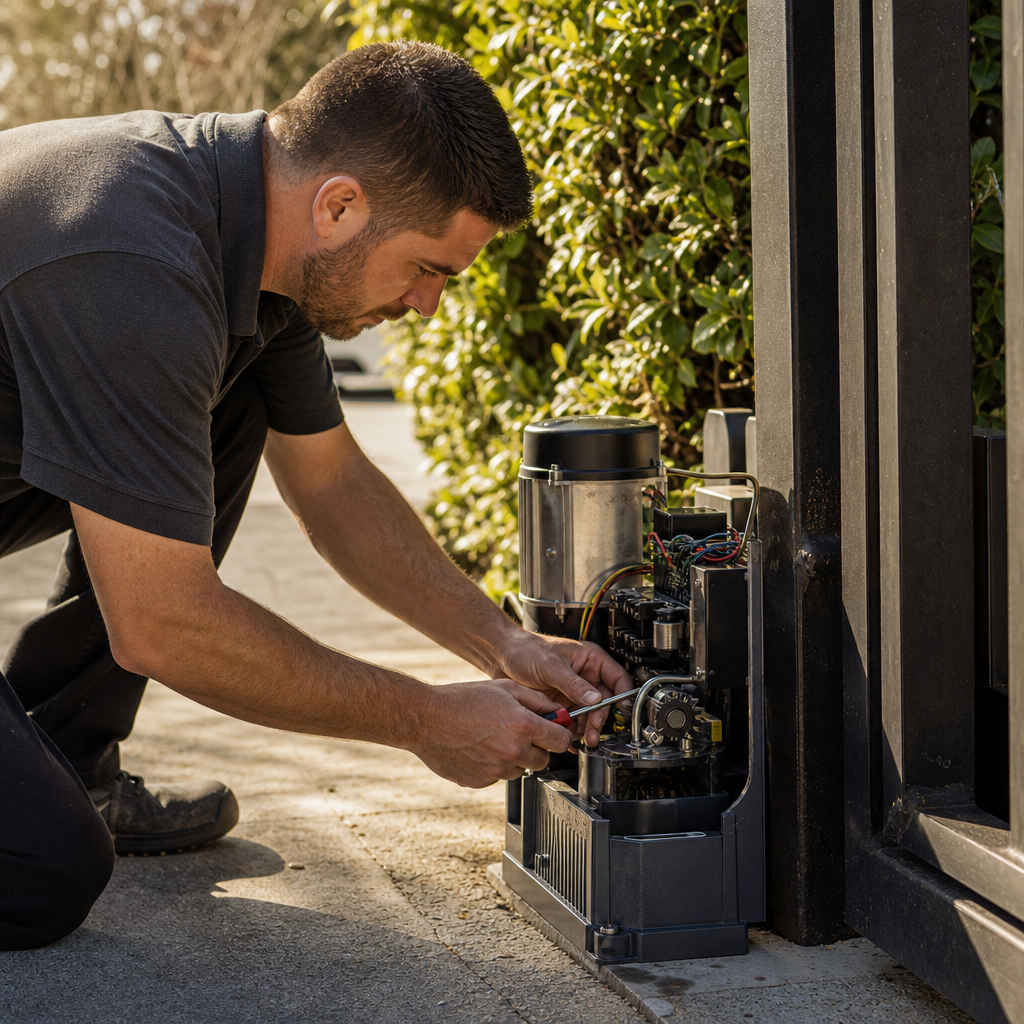
Mechanical Resistance Check: Many gate opener failures stem from mechanical drag issues. Soil shifting and thermal expansion can cause posts to lean and frames to bind, which increases friction and triggers the motor’s internal amperage limiters to cut power.
The Soil Shifting and Thermal Expansion Trap
When a gate post leans due to ground movement, the alignment shifts. Swing gates may sag, while sliding gates can grind against guide rollers or ground tracks. In addition, heat causes metal frames to expand. When the opener encounters excessive resistance, its internal torque sensor registers an obstruction and halts operation. As emphasized by True Blue Gate Repair Santa Ana, addressing the underlying mechanical resistance is necessary before replacing or recalibrating an opener.
Evaluating Hinges, Rollers, and Track Alignment
As general practical advice, isolate mechanical drag using these basic steps:
- Disconnect the operator: Pull the manual release pin or disconnect the drive chain or swing arm.
- Move the gate manually: Swing or slide the gate by hand through its entire travel path. It should glide smoothly. Scraping or heavy resistance indicates a mechanical or structural issue.
- Inspect key load points: Check for damaged rollers, bent tracks, cracked welds, or dry hinge bearings.
Step 4: Evaluate Control Board Relays and Remote Frequencies
Need driveway gate opener repair?
We’re available now — call for a fast, free estimate.
If mechanical movement is smooth and power is verified, open the control box to inspect the logic board for blown fuses, burnt relay contacts, or signs of moisture damage.
Reading Diagnostic Error Codes
- Review input indicator LEDs: Check the board’s diagnostic lights. If a safety or loop indicator remains lit, a connected accessory may be holding the gate open.
- Inspect physical board components: Look for darkened circuit board traces, damaged capacitors, or relays that fail to send output voltage to the drive motor.
Checking Antennas and Remote Receivers
Verify that the receiver antenna wire extends properly outside metal enclosures. Replace dead remote batteries and confirm that the radio receiver detects signals from transmitters and keypads.
Step 5: Calculate Repair Costs vs. Full Motor Replacement
Deciding between component repairs and installing a new gate opener depends on equipment age, part availability, and total wear. No reliable national average for driveway gate opener repair was found in the reviewed neutral sources. If repair estimates approach the cost of a modern system, replacing the operator is often the more practical long-term choice.
| Service Type | Limit Switch Tune / Minor Fix | Control Board Swap | Full Gate Opener Replacement |
|---|---|---|---|
| Typical Scope | Sensor alignment, limit reset, basic wiring | Logic board replacement, safety loop recalibration | New commercial or residential operator installation |
| Recommended System Age | General estimate: Under 7 years | General estimate: Under 10 years | General estimate: 10+ years or discontinued models |
| Safety Compliance | Maintains existing setup | Maintains existing setup | Meets current UL 325 safety standards (with updates in 2025-2026) |
When Component Repair Makes Sense
As a general estimate, targeted repairs are often practical when the opener is under eight to ten years old, the internal gearbox is intact, and structural components are in good condition. Replacing a capacitor, resetting limit switches, or installing a replacement circuit board can restore dependable function.
When to Choose Full Operator Replacement
When an operator is over 10 to 12 years old (as a general estimate), parts are discontinued, or the internal gearbox is damaged, replacement is typically recommended. Modern operators provide monitored entrapment protection meeting UL 325 standards, along with updated safety and control features.
Step 6: Select a Licensed Professional for Safe Execution
Automated gate operators combine electrical circuits with heavy moving hardware. Hiring a qualified professional helps ensure compliance with safety standards. UL 325 remains the core safety standard for automated vehicular gate operators, with recent updates noted in 2025-2026. Experienced technicians can distinguish between track binding and electrical board failures to avoid unnecessary component replacements.
Evaluating Contractor Licensing and Credentials
Always verify that your contractor holds appropriate state licensing, bonding, and liability insurance coverage. Working with a qualified access control professional helps protect your property and ensures that equipment warranties remain valid.
The Advantage of Professional Diagnostic Service
Professional technicians, such as the crew at True Blue Gate Repair Santa Ana, utilize dedicated diagnostic equipment and access genuine replacement components, facilitating accurate troubleshooting and effective repairs.
Frequently Asked Questions About Driveway Gate Opener Repair
How much does it cost to repair a driveway gate opener?
No reliable national average for driveway gate opener repair was found in the reviewed neutral sources. Total costs depend on the specific failure, the required replacement components, and labor rates for your area.
Why is my driveway gate opener not opening or closing?
Common causes include dirty or misaligned photo-eye sensors, a tripped circuit breaker or GFCI outlet, a dead remote battery, or mechanical gate binding. When structural wear or ground movement causes the gate to drag, the motor’s internal safety limiter stops operation to prevent damage.
Can a driveway gate opener motor be repaired or does it need replacement?
Many motor issues can be repaired if the internal gears and motor windings are undamaged. Replacing capacitors, limit switches, belts, or control boards can restore operation. However, if internal drive gears are stripped, windings are burnt, or the unit is beyond its typical lifespan, replacement is generally the more reliable solution.
How do I troubleshoot a driveway gate opener that stopped working?
As general practical advice, first confirm that the circuit breaker and outdoor outlets have power. Next, inspect the safety photo-eyes to verify clean lenses and proper alignment LEDs. Finally, disengage the manual release to move the gate by hand and check for mechanical resistance or physical track issues.
How long does a typical automatic driveway gate opener last?
As a general estimate, residential gate openers often last between 10 and 15 years, while high-cycle commercial units may last 8 to 12 years depending on usage, environmental conditions, and maintenance frequency. Routine lubrication and regular cleaning help extend component life.
When should I call a professional for driveway gate opener repair?
You should contact a professional if you encounter electrical supply faults, damaged circuit boards, severe mechanical binding, or persistent reversal issues. Qualified technicians, such as the team at True Blue Gate Repair Santa Ana, have the necessary diagnostic tools to repair systems safely in accordance with UL 325 standards.
Need driveway gate opener repair?
We’re available now — call for a fast, free estimate.
Sources
- [PDF] 2015 Annual Report – Consumer Product Safety Commission – cpsc.gov (2015)
- New Safety Standard for Automatic Security Gates Helps … – cpsc.gov (2000)
- Update of Automatic Garage Door and Garage Door Openers Entrapment Incidents to Children under 15 Years of Age Reported to CPSC Between December 1, 1996 and June 30, 2003 – cpsc.gov (2003)
- Over 90% of commercial gates deemed unsafe – Gate Safe – gate-safe.org
Related reading: Commercial Gate Service | Call Now-10% Off | Same-Day Service | Free Estimate
Related reading: Commercial Electric Gate Repair Near Me | Call Now-10% Off | On-Site in 60 Minutes | Free Estimate
Related reading: Local Gate Repair | 10% Off & Free Estimate | On-Site in 60 Minutes
Frequently Asked Questions
How can I tell if my gate opener issue is caused by shifting ground rather than a blown motor?
Disengage the manual release key or pin and swing or slide the gate through its full path by hand; heavy resistance indicates structural binding rather than electrical failure. When mechanical friction triggers internal motor limiters, True Blue Gate Repair Santa Ana can realign hinges, tracks, and leaning posts to restore smooth movement.
Why does my automatic gate opener click and reset instead of opening the gate?
This usually happens when an aging battery backup or failing power transformer drops voltage sharply under the motor's initial starting load, forcing the logic board to reboot. True Blue Gate Repair Santa Ana performs active load testing on electrical feeds and battery banks to quickly isolate and fix power delivery faults.
Can older driveway gate openers be upgraded to comply with modern UL 325 safety standards?
Many existing systems can be retrofitted with modern monitored photo-eyes and entrapment protection devices if the logic board supports monitored safety circuits. For discontinued models or operators over ten years old, True Blue Gate Repair Santa Ana provides free estimates to replace obsolete units with fully compliant, reliable systems.
About the author
 |
Kevin Bradley Kevin Bradley is a certified access control technician and technical writer with over a decade of experience in the residential and commercial security sector. He holds a Bachelor of Science in Industrial Technology from California State University, Fullerton, giving him a strong foundation in automated systems and mechanical repair. Specializing in emergency gate repairs and opener replacements, Kevin provides property owners in Southern California with practical, reliable advice for maintaining secure entry points. |